

Quick summary: The first electrochemical battery was created by Alessandro Volta in 1800—a stack of zinc and copper discs separated by cardboard soaked in salt water. After 226 years, that same principle was miniaturized into lithium-ion battery cells with a density of 250-300 Wh/kg, roughly five times that of lead-acid batteries, and that is why the phone in your pocket is as thin as it is today.
The power bank in your pocket now weighs about 400 grams and can fully charge an iPhone four to five times. 226 years ago, to produce a current many times weaker than that, people had to stack dozens of metal discs nearly as tall as a forearm—and it leaked salt water onto the table.
Who invented the first battery?
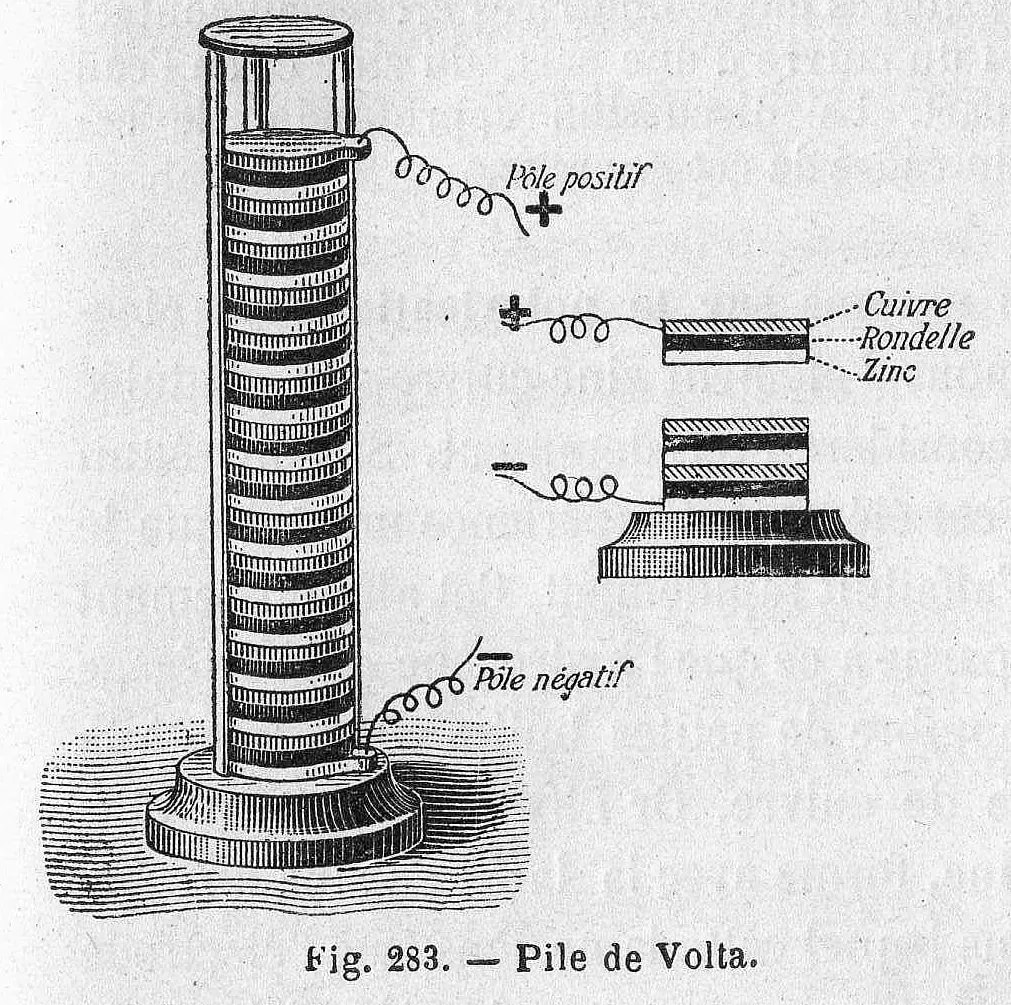
Alessandro Volta, in 1800. He alternated zinc and copper disks, placing a piece of cardboard soaked in salt water between each pair. It was humanity's first continuous direct-current power source, and the unit "volt" has been named after him ever since.
The interesting thing is that it began with an argument. Luigi Galvani dissected frogs and noticed that their legs twitched when touched by a metal knife, leading him to conclude that "animal electricity" was present in the creatures' bodies. Volta disagreed—he believed that the frog merely served as a conductor, while the electricity arose where two different metals made contact. The stack of zinc-copper discs was the evidence he devised to refute this claim, and it gave rise to the entire field of electrochemistry.
Just a few weeks later, two British scientists used a Volta battery to split water into hydrogen and oxygen. The drawbacks were clear: the voltage dropped quickly, the brine leaked out, and the zinc disc corroded even when unused. But for the first time, people had a continuous source of electricity to study.
Why could the Volta battery only run for about an hour?
This was because hydrogen bubbles adhered to the copper plate and blocked the flow of electricity—a phenomenon called polarization. In 1836, John Frederic Daniell solved the problem by dividing the battery into two compartments: zinc immersed in sulfuric acid and copper immersed in copper sulfate solution, separated by a porous partition. The battery ran steadily for many hours.

The Daniell cell became the standard power source for telegraph networks for many decades. In other words, the first electrical signals to cross the ocean were transmitted using this type of battery.
Where do the AA batteries in TV remote controls come from?
It began with the Leclanché battery in 1866. Georges Leclanché combined zinc with manganese dioxide in an ammonium chloride solution—an inexpensive, easy-to-produce design that did not require frequent addition of acid. The zinc-carbon and alkaline batteries sold in stores today are still, in chemical terms, direct descendants of that design.

The real turning point came about thirty years later, when the liquid electrolyte was replaced by a paste: the dry cell was born. No spills, easy to carry—and that was when the battery left the laboratory to slip into a trouser pocket.
When did rechargeable batteries first appear?
Since 1859, much earlier than many people think. Gaston Planté developed the lead-acid battery: charge it, and it can be used again. Heavy and bulky, but capable of delivering high current, it still sits under the hood of your car today, with its operating principle having changed very little in 167 years.
In 1899, Waldemar Jungner introduced the nickel-cadmium (NiCd) battery: lighter and rechargeable many more times. In return, cadmium is highly toxic, and the battery suffers from the "memory effect" — charging it before it is fully discharged causes its capacity to drop the next time. Anyone who used a brick mobile phone in the 90s and was told to "drain it completely before charging" was experiencing the lingering consequences of the NiCd era, whereas today's batteries no longer require that.
What did lithium-ion change?
It changed energy density. Sony commercialized the first lithium-ion battery in 1991, based on research by John Goodenough, Stanley Whittingham, and Akira Yoshino — all three of whom shared the 2019 Nobel Prize in Chemistry. A lithium-ion battery holds about 250-300 Wh per kilogram, roughly five times that of a lead-acid battery.
That number gave rise to smartphones, thin laptops, wireless earbuds, and electric vehicles. Without it, every device you use would have to be much larger or last much shorter. The popular variation today is lithium polymer: it is still lithium-ion chemistry, but its gel-form electrolyte makes it thinner and allows for more flexible shapes.
226 years of battery history, packed into one chart
| Year | Battery type | Inventor | Main characteristics |
|---|---|---|---|
| 1800 | Volta battery | Alessandro Volta | The first continuous power source, lasting about 1 hour |
| 1836 | Daniell battery | John Frederic Daniell | Stable for several hours, supplying power to the telegraph network |
| 1859 | Lead-acid | Gaston Planté | The first rechargeable battery, still used in cars today |
| 1866 | Leclanché | Georges Leclanché | Inexpensive, the precursor to the modern AA battery |
| 1899 | NiCd | Waldemar Jungner | Can be charged many times, toxic, has a memory effect |
| 1991 | Lithium-ion | Commercialized by Sony | 250-300 Wh/kg, paved the way for portable devices |
| 2026 | Lithium polymer | — | Thin compressed gel cell, fast charging 20-22.5W, integrated cable |
What does today's generation of power banks look like?
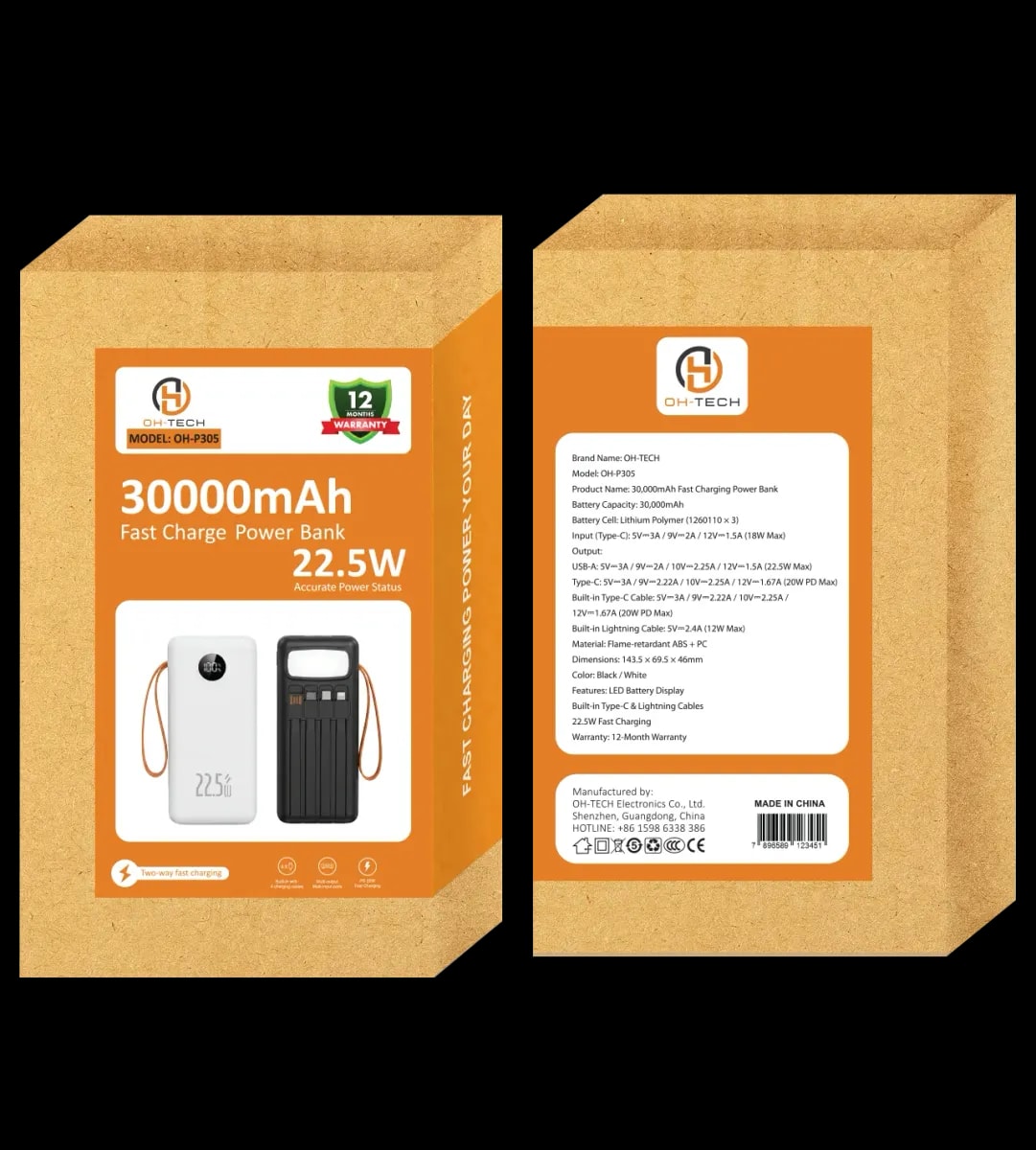
To see where that 226-year journey ends, just look at a modern power bank. OH-P305 is an easy-to-visualize example: 30.000mAh housed in three lithium polymer cells, weighing less than half a kilogram, yet capable of keeping your whole group powered during a weekend trip.
Three things worth noting about this generation, which the batteries of Volta or Leclanché did not have:
- Built-in cable — Type-C and Lightning are permanently attached to the casing, so you never have to remember to bring a cable.
- Two-way fast charging — outputs 22.5W via USB-A, 20W PD via Type-C, and recharges itself at 18W.
- Percentage LED display — know exactly how much is left, instead of guessing from four blinking lights.
For something lighter and more compact to carry in your pocket every day, there’s the 10.000mAh OH-P301W; for a more moderate capacity, the OH-P204 20.000mAh. Browse the full range in the power bank category, or pair it with a GaN charger to shorten charging time.
How can lithium-ion batteries last longer?
Three principles, in brief: keep the battery level between 20-80% whenever possible, avoid high temperatures, and don’t leave the battery sitting at 0% for days.
Heat is the real killer of batteries. Leaving a power bank in a car parked in the midday Saigon sun — the cabin can reach 60-70°C — causes more than 100 times as much damage as normal charging. Battery swelling almost always stems from heat or a hard impact, and only rarely from "charging overnight," as many people still fear.
What about the advice that the first charge should last a full 8 hours? That was true for NiCd batteries thirty years ago, and it stopped being true long ago.
Frequently asked questions
When was the first battery in the world created?
In 1800, Alessandro Volta created it—a stack of zinc and copper disks separated by cardboard soaked in salt water, called a Volta battery. Previously, in 1938, people discovered the "Baghdad battery"—a ceramic jar containing copper and iron rods, dating back to around 250 BC—but its true purpose is still disputed.
What is the difference between lithium-ion and lithium polymer batteries?
They have the same lithium-ion chemistry but differ in their electrolyte. The lithium polymer version uses a gel instead of a liquid solution, making it thinner and more flexible in shape and safer when dented. It is commonly found in phones and power banks.
How many times can a 30.000mAh power bank fully charge an iPhone?
Approximately 4-5 times. iPhone battery capacity ranges from 3.300-4.400mAh depending on the device generation, but due to losses during voltage conversion, in practice you only receive around 60-70% of the capacity stated on the casing.
Why does the battery swell, and should you continue using it?
Battery swelling is caused by gas generated when the electrolyte decomposes, usually due to high temperatures, prolonged overcharging or a cell being impacted. Stop using it immediately, do not puncture it, and do not throw it into the regular trash; take it to a battery collection point.
Does charging overnight harm the battery?
With newer devices, it almost does not, because the charging circuit automatically stops when the battery is full. The downside is that the battery is continuously kept at 100% in a hot environment—so if charging overnight, place the device in a well-ventilated area and remove the thick case.
Conclusion
Two hundred and twenty-six years, from the stack of metal plates Volta immersed in salt water on his desk to the pocket-sized battery pack. The funny thing is that the underlying principle hasn’t changed: it’s still two different materials, a conductor in between, and electrons flowing from one side to the other. What has changed is that we can pack more energy into a smaller space — so much more that no one notices we’re carrying an entire miniature power plant.
Archival image: Wikimedia Commons (public domain).